Wet Pavement Season: Manchester Photographers Who Stopped Waiting for Sunshine
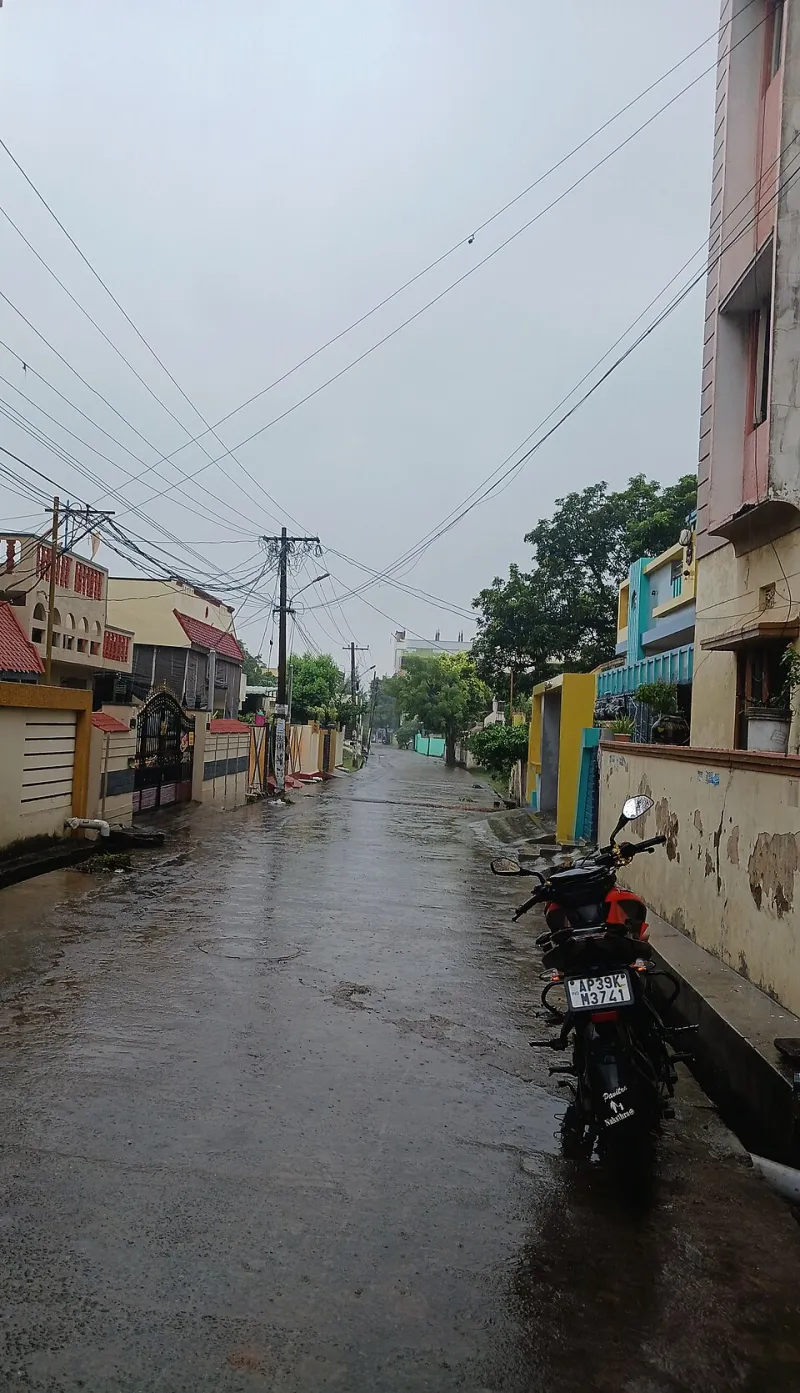
Photo: PVRMurty1944, CC0, via Wikimedia Commons
There is a particular kind of light in Manchester in November. Not dramatic, not golden, just a soft, even, slightly blueish wash that arrives around nine and never quite leaves. For years the received wisdom was to wait it out — book a week in the Peaks, save the good ideas for April, keep the camera in the bag until the sky did something interesting. That's changing. A quiet, stubborn shift has taken hold among photographers here, and it goes something like this: the drizzle isn't interrupting the project, it is the project.
The forecast is not the assignment
"I used to check the weather app like it was a referee's decision," says Ruth Ackroyd, a Salford-based documentary photographer who has spent the last few years shooting almost exclusively between October and March. "Then I realised I'd been editing out the most honest version of the city. Manchester doesn't look like anywhere else in the sun. It looks like everywhere. In the rain it looks like itself."
That sentiment comes up again and again. Photographers who once saw grey skies as a technical problem — no contrast, no shadow, no punch — now describe overcast conditions as the most forgiving light they can get. No blown highlights at midday. No racoon-eyed portraits at three in the afternoon. Just an enormous, free, softly diffused softbox hanging over the whole of Greater Manchester, roughly two hundred days a year.
Keeping the gear alive
The practical barriers are real, and nobody pretends otherwise. Rain gets into seals, into zoom barrels, into the hot shoe, into the one gap you forgot existed. The shooters we spoke to were refreshingly unsentimental about it.
- Rain sleeves over heroics. A £15 cover from a camera shop on the Northern Quarter's edge does more for your kit than any amount of confidence. Shower caps, sandwich bags and elastic bands remain undefeated.
- Don't change lenses outdoors. Ever. Not under a jacket, not under a bridge, not quickly. Find a café, a library, a station concourse.
- Silica gel by the handful. Keep sachets in the bag and in the case. If a body does get damp, dry it slowly, lens off, in a warm room, not on a radiator.
- Cloths, plural. One microfibre is a smeared filter waiting to happen. Four is a working system.
- Tripods hate grit. Wipe and dry the legs before collapsing them, or the locks will seize by February.
"The gear thing is mostly about discipline, not money," says Idris Khan, who shoots architecture and street around Castlefield and the canals. "I've done full days in proper rain with a decade-old body and a hood. My rule is simple: if my hands are wet, the camera comes out. If it's tipping it down, the camera stays in and I shoot from under the arches."
Flat light is not the same as boring light
The other half of the equation is learning to use the grey rather than fight it. Overcast skies flatten everything, which is bad for landscape drama and excellent for almost everything else. Colour suddenly behaves. A red coat on Market Street reads like a flare. A neon sign over a takeaway on Oldham Street doesn't have to compete with the sun. Textures — wet slate, brick, the ridged rubber of a tram platform — come up beautifully when there's no hard shadow cutting across them.
"I tell people to look for the small contrasts," says Ackroyd. "A grey street and one yellow umbrella. A wet wall and a dry doorway. The eye needs somewhere to land, and under a flat sky you can decide where that is instead of the weather deciding for you."
Reflections are the payoff
If there's one technical reason to go out in the rain, it's the ground. Manchester doesn't so much have puddles as a second city laid out on the pavement, and the photographic possibilities are almost embarrassing.
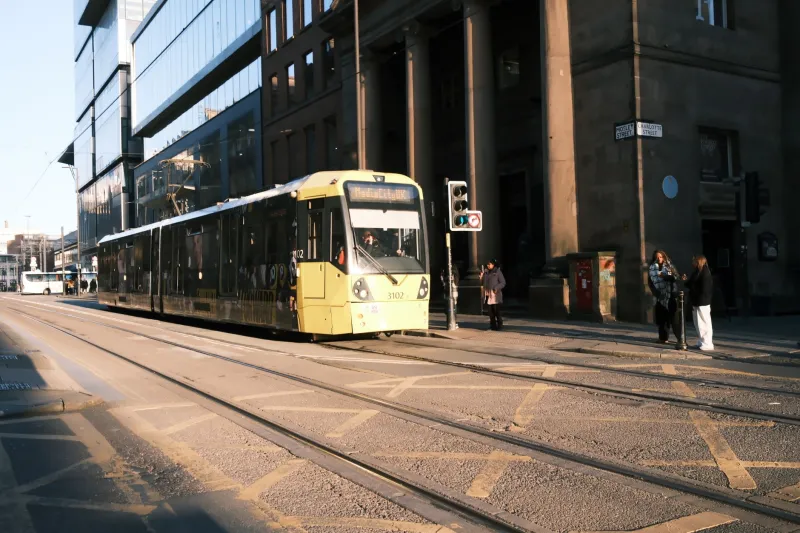
Get low — genuinely low, knee or chest height — and focus on the reflection rather than the source. The Castlefield basins, the Rochdale Canal towpath, the slick tarmac outside Piccadilly station and the tram tracks along Oxford Road all offer reliable mirrors after a shower. Flip the frame in editing and you get a photograph that looks like a photograph of somewhere else entirely.
Idris Khan's tip: "Don't wait for a clean puddle. The interesting ones have grit, leaves and a bit of oil in them. That's the texture."
Slower shutters, steadier hands
Rain gives you movement, and movement rewards patience. Shutter speeds between a quarter of a second and two seconds turn umbrellas into soft streaks and passing traffic into ribbons of light. A cheap variable ND filter is the single most useful thing in a wet-weather bag, because it lets you slow down even on a bright grey afternoon.
Tripods are awkward in a crowd, so most of the photographers we spoke to brace against walls, railings and bridge parapets instead, or carry a small beanbag. "I've shot long exposures off a bin lid on Deansgate," Khan admits. "It worked. It's not glamorous."
The ethics of a wet street
There's a less discussed side to all of this. Bad weather makes people vulnerable, and a camera pointed at somebody sheltering in a doorway or huddled at a bus stop is a very different act from a sunny street portrait. The photographers we spoke to were unanimous on the basics: ask before you shoot, keep your distance, don't block pavements, don't frame someone's worst afternoon as your moody composition, and accept a no without negotiating.
"If someone's got their hood up and their head down, they've told you they don't want to be looked at," says Ackroyd. "I'll shoot the street, the architecture, the reflection. I won't make a project out of somebody's bad day. Consent isn't a fair-weather rule."
Grey, printed properly
Here's where it comes back to the physical. Flat-lit files can look muddy on a screen and then sing on paper, provided you resist the urge to crank the clarity slider until the whole thing looks like a Victorian fog. The print specialists we've chatted to over the months make the same point repeatedly: greys need texture to sit on, so a matte cotton rag will hold the subtle separation between wet slate and wet concrete in a way a glossy surface simply won't. Get a small test print before you commit to anything larger — it's the only way to see whether your careful grey is actually grey or has quietly gone a bit green.
Start with one wet hour
The gear can be a single body, one lens, a sleeve and a cloth. The route can be the one you already walk. The only real requirement is deciding, in advance, that the weather is the subject rather than the excuse. Manchester spends a good chunk of the year in this register. It would be a shame to keep waiting for the other one.
Next dry-ish Saturday, pick a canal, a bridge or a wet stretch of pavement, and go and look at what's underneath.