The Long Way Home: Manchester Photographers Who Made a Project of Their Daily Commute
The 192 bus at 7:42am is not, on the face of it, a creative opportunity. It is a queue of coats, a scrum of headphones, and a window that smells faintly of yesterday’s chips. But for a growing number of Manchester photographers, the daily commute has become the project: same route, same stops, same faces, different light.
The appeal is not novelty. It is the opposite. When you walk the same street every day, you stop looking for something new and start noticing what was always there: the way the sun hits the bus shelter in November, the bloke who arranges his cans in the same order, the slow change of shop fronts from one season to the next.
The 7:42 to Altrincham
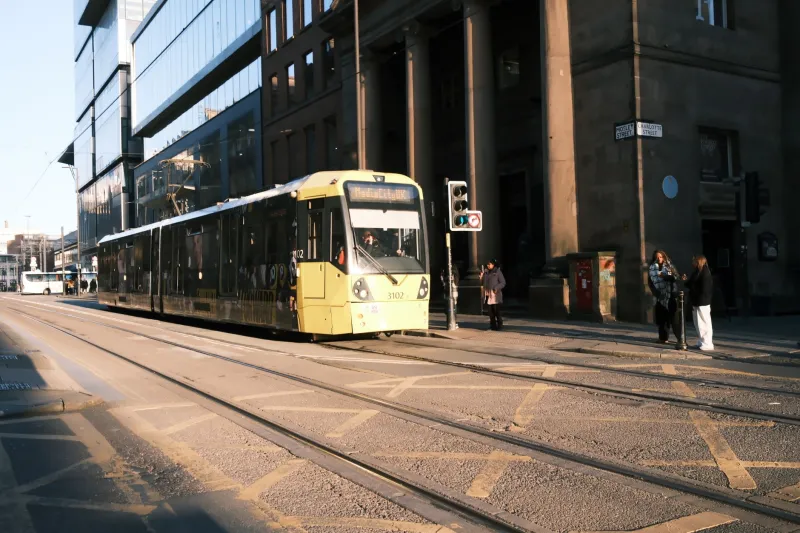
Nadia has been photographing her Metrolink commute from Cornbrook to Altrincham since 2023. It began as a way to use the dead time. ‘I told myself I’d take one frame a day, and if it was boring, fine,’ she says. ‘Boring was the point. I wasn’t trying to make bangers. I was trying to pay attention.’
Her project, still untitled, is now hundreds of frames: reflections in the window, hands on poles, the same commuter asleep in the same seat, the platform clock, the seasonal shift from dark mornings to bright ones. She shoots on a small fixed-lens camera and keeps the editing minimal. ‘The constraint is the whole thing,’ she says. ‘If I could go anywhere, I’d chase novelty. The tram forces me to look properly.’
The same street, different light
Chris walks from Levenshulme to Longsight most mornings. He started taking photographs on that route during a stretch of freelance work when he had no time for ‘proper’ photo trips. ‘I felt like a fraud calling it a project at first,’ he says. ‘It was just my walk to the bus. But after a few months, I realised I was making a document of a place changing — shops closing, a new bakery opening, the same people waiting at the same crossing.’
His advice is to resist the urge to make every frame a statement. ‘The good stuff arrives in the edit,’ he says. ‘You shoot the same corner fifty times because one day the light does something strange, or someone walks through who makes the whole picture click. You can’t plan that. You can only be there.’
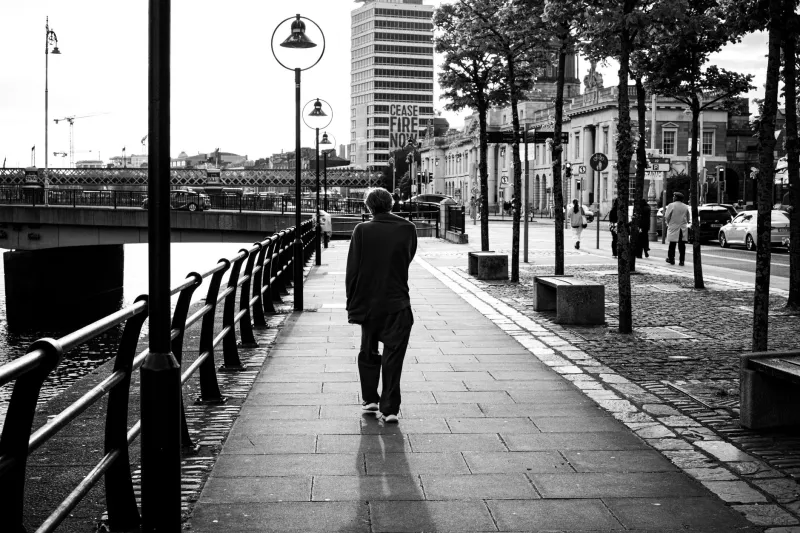
Joe, a photographer based in Chorlton, took a different route: the same walk around his block, every evening, for a year. He shot on a 35mm lens, often in black and white, and printed a small zine at the end of it. ‘It taught me that a project doesn’t need a grand location,’ he says. ‘It needs a rule and a bit of stubbornness.’
Why repetition works
A repeat-route project is not just a photographic exercise. It is a way of building a relationship with a place, and with the people in it. You become a familiar face. You notice patterns. You learn when the light is good and when the street is empty. You stop treating the everyday as a backdrop and start treating it as the subject.
There is also a practical benefit: you do not need to find time for a photo walk. The walk is already happening. The camera just comes along.
Where to see this work
Some of it lives in small exhibitions and local showcases. A window display at a café on Beech Road in Chorlton recently featured a set of commuter portraits printed cheaply and taped to the glass. Manchester Central Library’s display cases have hosted zine-style photo projects from local photographers. And online, the work circulates through newsletters, local photo collectives and small print runs rather than big gallery walls.
That suits the scale of the projects. These are not grand statements. They are accumulations: a year of mornings, a season of bus stops, a street seen so often it becomes a friend.
Start your own repeat-route project
- Pick a route you already travel: the walk to the tram, the bus to work, the school run, the dog walk.
- Set a simple rule: one frame a day, or one frame each way, or one roll a week.
- Use a fixed lens or a phone. Constraint helps you see.
- Shoot at roughly the same time so you can compare light, weather and people.
- Keep a notes file. Write down names, overheard lines, small changes.
- Edit in batches, not every day. Sequences emerge over time.
- Be respectful. You are photographing a real place, not a set.
- Give yourself permission to be bored. Boredom is often where the seeing starts.
The commute is not the obstacle to the project. It is the project. The 192 will keep coming. The tram will keep humming. The street will keep changing, slowly, while you are looking.