Trestle Serious: Why Manchester’s Print Sellers Are Taking Their Work to the Market
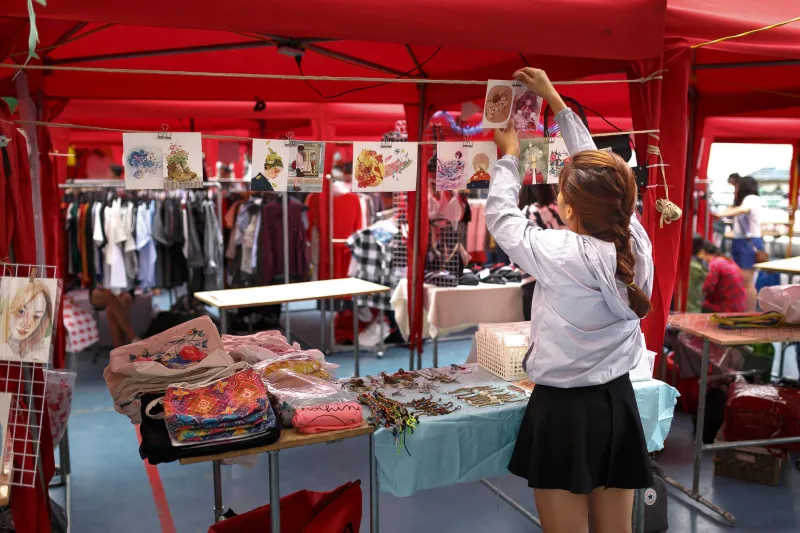
On a Saturday morning in Levenshulme, between the sourdough stall and a table of vintage denim, there is a small queue forming. It is not for bread. A photographer is taping a row of A4 prints to a folding board, weighing down the corners with pebbles nicked from a houseplant pot. By half ten, someone is holding a print of a rain-streaked bus window at arm's length, deciding whether it would work in a hallway. This is not a private view. It is a market, and in 2026 it is becoming one of the most useful rooms in Manchester's photo scene.
The table is the edit
A gallery show asks you to fill a wall. A market stall asks you to fill a table, which is a different craft entirely. Sellers describe the same learning curve: the image that looks magnificent on a portfolio site can disappear entirely when it is laid flat next to a bag of oranges and a queue of people deciding what to have for lunch.
The photographers doing this well edit for browsing, not for prestige. They think in layers. From six feet away, the table needs a clear shape - a colour, a subject, a mood that pulls someone in. From three feet, there needs to be a sequence that rewards a slow scan. Up close, the print has to hold: paper stock, contrast, whether the blacks are actually black or just muddy grey. One seller calls it "the three-speed edit". If a print only works when you are standing still and squinting, it stays at home.
Small is not a compromise. Many stallholders favour A4 and A3, with a handful of larger pieces as anchors. Postcards and zines do the work of a business card, a conversation starter and a low-risk first purchase. The result is a table that feels generous rather than precious. You can look without feeling like you need to know the artist's CV first.
Pricing for people who are actually there
Market pricing is its own discipline. A framed edition in a gallery carries a different set of expectations; a print bought next to a coffee van has to make sense in a Saturday budget. Sellers talk about the £15 to £40 range as a sweet spot for open-edition or small-edition prints, with zines at a fiver or a tenner. It is not about undervaluing the work. It is about recognising who is standing in front of you.
The practical maths matters too. A stall is not a consignment arrangement; you carry the stock there, you carry it home, and you pay for the table whether you sell anything or not. That pushes sellers towards lighter, flatter, more portable formats. It also encourages bundling - two prints for a round sum, a zine thrown in with a larger piece - and clear card payments. Several sellers mention that a QR code for a card reader has quietly done more for their confidence than any amount of Instagram strategy.
There is a useful honesty in this. When someone hands over a twenty-pound note, they are not buying a reputation. They are buying an image they want to live with. That is a cleaner transaction than a lot of artists admit.
Face-to-face critique, without the panel discussion
Nothing prepares you for the market feedback loop. People will tell you exactly what they think, often in ways no gallery invigilator would permit. A print might get a shrug. Another might get a long story about a grandmother's kitchen, a lost dog, a bus route that no longer runs. Neither response is a review, but both are data.
Sellers say the useful lesson is learning to separate silence from rejection. A person who stops is already interested; a person who stops and picks something up is nearly there; a person who stops, picks something up and then puts it down is telling you something about price, size or subject. You do not need a feedback form. You need to watch the table.
The low stakes help. There is no private view to endure, no panel talk to sit through. If a conversation goes nowhere, the next person is already asking whether you have anything of the canal in winter. That rhythm suits photographers who would rather talk about pictures than about themselves.
A gallery with no door policy
What makes the market stalls work is not just sales. It is the fact that they create a room where nobody has to pretend to be a collector. Football shirts, dog walkers, students, people who have never bought art before: they all drift past. The stall is a low-pressure gallery for the city's photo community, and it is open to anyone who can be bothered to turn up.
That looseness is the point. Photographers meet each other across neighbouring tables. Zine makers swap stock. Someone who came to buy a present leaves with a name to look up later. In a city with no shortage of photography courses and camera clubs, the market is doing something different: it is putting work in front of people who are not already looking for it.
Doing the table properly
There are practicalities. Manchester weather does not respect a paper-based display, so weights, plastic wallets and a plan for rain are not optional. Signage needs to be readable at a glance. A QR code to a mailing list is worth more than a QR code to an Instagram grid, because one is a relationship and the other is a scroll. And it helps to have a single sentence ready for the question every stallholder hears: "What do you shoot?"
But the deeper skill is learning to be present. A market stall is a small shop with no walls, and the person behind it is part of the display. The photographers who do well are not necessarily the most extroverted. They are the ones who can read when to talk and when to let someone look.
In 2026, the gallery is not going anywhere. But the trestle table is earning its place alongside it. It is cheaper, messier, more exposed and, for a growing number of Manchester photographers, a much better way to find out what their work actually does when it leaves the screen and meets a stranger.