The Feed Doesn't Pay the Rent: Manchester Photographers on Logging Off and Printing More
Photo: Found5dollar, CC BY-SA 4.0, via Wikimedia Commons
Ask a Manchester photographer how their week went and you'll increasingly get two answers: what they shot, and what they posted. More and more people around the city are quietly binning the second one.
Not with a dramatic flounce — no farewell grid post, no tearful Story. Just a slow, deliberate unsubscribing from the idea that a photographer's worth is measured in uploads per week. The camera comes out. The phone goes face down on the table. The print goes on the wall.
The Bit Nobody Warned You About
There's a version of freelance photography that runs on a treadmill: shoot, edit, crop for the grid, crop again for the reel, write a caption with a hook, schedule it for 7pm, reply to comments, repeat. Somewhere in there, actual work happens.
The trouble is that the treadmill doesn't feel optional. For anyone chasing commercial work in Greater Manchester — weddings, hospitality, product, the endless conveyor of new bars and barbers and bakeries — a visible online presence has been treated as the entry fee. No feed, no enquiries. That was the received wisdom for the best part of a decade.
What's changed is the maths. Reach is patchy, engagement is unpredictable, and the amount of unpaid labour required to keep the machine ticking over has crept up and up. Several photographers I've spoken to around Ancoats and the Northern Quarter describe the same realisation: they were spending more hours a week on distribution than on making pictures, and their best-paid jobs were still arriving by email from someone who'd seen a print in a café.
What the Algorithm Actually Wants
It's worth being blunt about the mismatch. A platform rewards frequency, novelty and a certain flattening of style — the images that perform are the ones that read in half a second on a smeared phone screen at a bus stop on Oxford Road.
A good photograph, on the other hand, often needs time. It needs a second look. It needs to be big enough that you notice something new in it on the fourth viewing. Those two things aren't just different — they're frequently in opposition.
A documentary photographer based in Salford put it to me this way: "The stuff that does well online is the stuff I'd have thrown away ten years ago. The stuff I'm proudest of just sits there getting forty likes and a comment from my mum."
That's not a moan about vanity metrics. It's a description of a feedback loop that quietly teaches you to make worse photographs.
The Print Does Something the Post Can't
Here's where Manchester's print culture becomes more than a side hustle. A zine on a table at a fair, a framed set in a Chorlton café, a run of thirty risograph prints sold at a market stall — these are slow objects. They cost money to make and they cost money to buy, which means somebody had to decide.
That decision is the point. When someone hands over twelve quid for a print, they're not engaging, they're committing. Photographers who've made the shift describe it less as marketing and more as a recalibration of what the work is for.
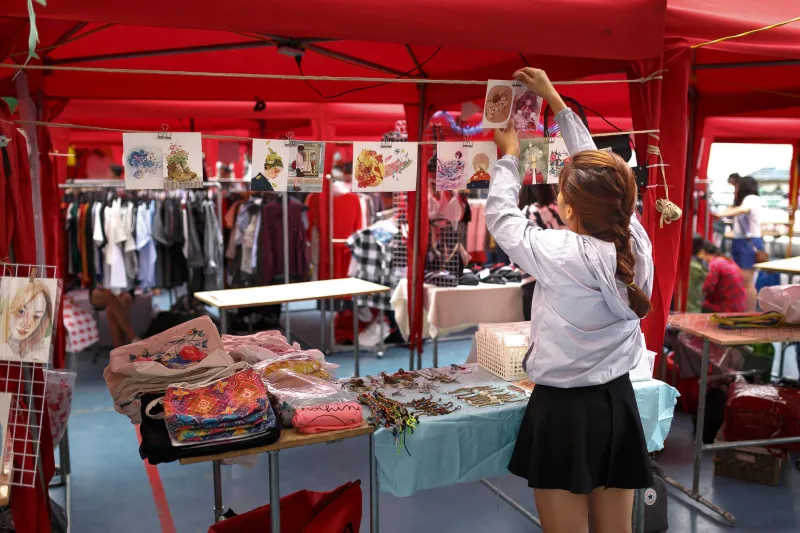
There's a practical side too. A stall at a weekend fair in a former mill off Oxford Road, or a shared table at a zine event in Stockport, will often generate more genuine conversation — and occasionally more income — than a month of scheduled posts. You meet people. People meet your work. Nobody's counting impressions.
Boundaries That Don't Require Becoming a Hermit
This isn't an argument for disappearing. Very few working photographers can afford to be invisible, and nobody sensible is suggesting you delete your accounts and move to a bothy in the Peak District.
The people I've spoken to have mostly landed on quieter compromises:
- One platform, not four. Pick the one where your actual clients and peers live and let the rest go fallow.
- Batch, don't broadcast. Upload once a fortnight from a folder, rather than filming the process of having ideas.
- Separate the work phone. A cheap second handset with the apps on it, switched off at 6pm, is a surprisingly effective piece of kit.
- Post the print, not the process. If it's going on a wall, it's worth showing. If it's a photo of you holding a lens cap, it probably isn't.
- Say the boundary out loud. Clients in 2026 are far less surprised by "I don't do same-day delivery of social assets" than photographers expect.
One freelance events photographer in Withington told me she now quotes social media delivery as a separate line item. Most clients, she says, decline it. "And then they book me anyway, because the pictures were good."
What Counts as Work, Then?
This is the question the scene is really chewing on. For years the industry has treated visibility as labour — grinding out content, maintaining a persona, being present. But presence isn't the same as output, and output isn't the same as craft.
A photographer who spends a Saturday walking the Rochdale Canal with one lens and comes back with four usable frames has done work. A photographer who spends that Saturday building a carousel has done admin. Both are necessary sometimes. Only one of them makes the pictures better.
Manchester has an unusually strong infrastructure for the second kind of work — shared darkrooms, photobook clubs, print fairs, a camera-shop scene that actually talks to its customers. That's the machinery for depth. It's just been drowned out by the noise of a feed that never stops asking for more.
The Slow Bet
The case for logging off isn't that social media is evil. It's that the trade has been badly skewed: photographers giving away enormous amounts of time and creative energy in exchange for a vague promise of being seen.
Printing more, showing less often, and letting the work accumulate is a slower bet. It doesn't scale. It won't go viral. But it does mean that when somebody finally stands in front of your pictures — on a wall, in a book, on a table at a fair — there's something there worth standing in front of.
In a city that's spent two decades learning to sell itself in fifteen-second bursts, that's a quietly radical position. And it's spreading.